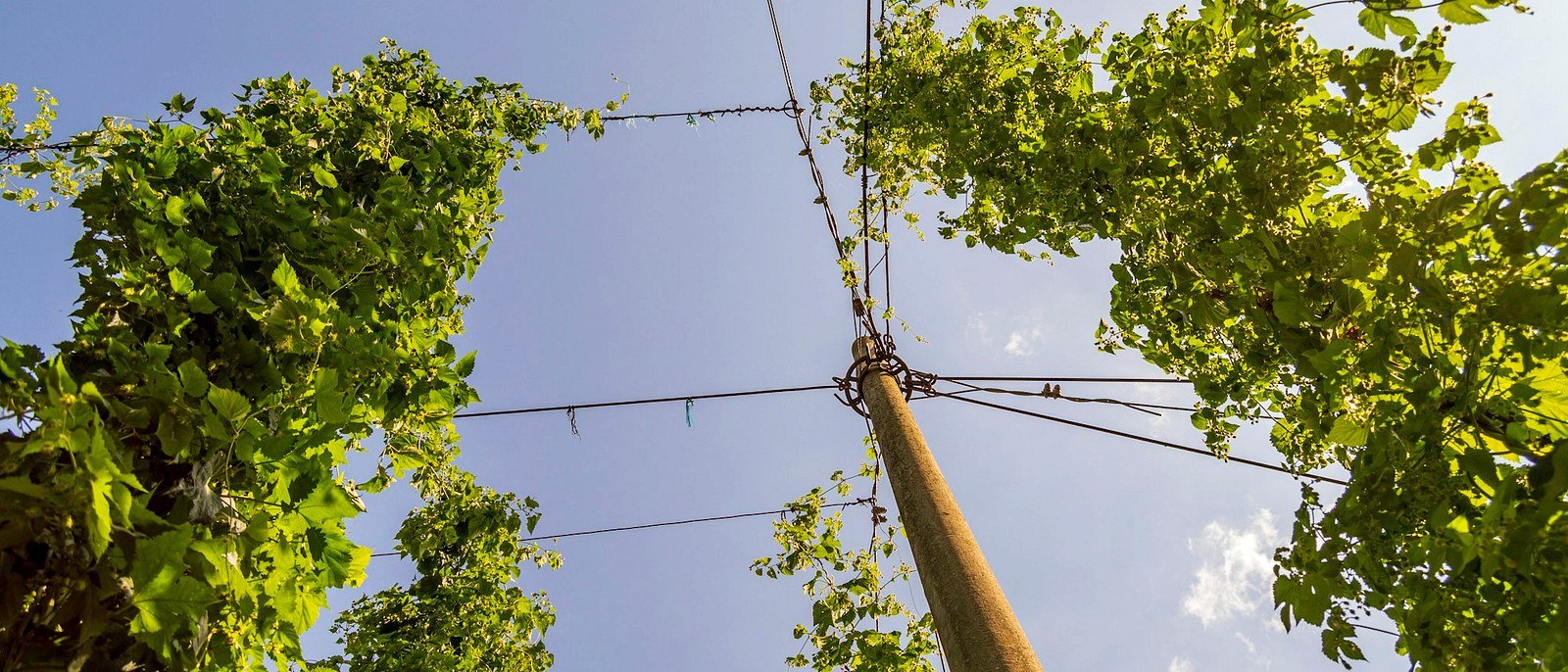
When a customer asks me why their beer smells of mango, my answer often fits in three words: it's the hops. True, and it explains nothing at all, I know that as I say it. Here's the long version, the one I never have time for. Three things to remember, and you'll read an IPA label without needing me.
Guess whether the hops came in hot or cold
Hops carry two very different things. On one side, bitter resins (alpha acids), which only dissolve into beer if you heat them for a long time. On the other, aromas, volatile: leave them an hour in a boiling liquid and they leave with the steam.
So it's not the quantity that decides the result, it's the moment you add them. Early in the boil, you extract bitterness and lose the aroma. After or during fermentation, cold, the aroma stays intact and the bitterness barely moves. That's what labels call dry hop. A NEIPA is massively cold hops: a nose of mango and pineapple, gentle bitterness. A West Coast IPA does the opposite and owns a firm bitterness, pine and citrus. Same plant, two worlds.
Your glass tells you on its own: smell it, take a sip, count three seconds. If the nose is huge and nothing biting rises behind it, the hops came in cold.
Keep it in the fridge, the aroma goes before the bitterness
These aromas are fragile. They oxidise within months, while bitterness lasts much longer. An IPA forgotten a year in a cupboard doesn't get more bitter, it gets lopsided: the fruit is gone, the bitterness sits alone in the middle, with nothing to balance it.
Two levers to avoid that. The date first: count three to four months on a bottle, up to a year on a well-stored can. And above all the cold, which counts at least as much as the date. A beer kept in the fridge barely moves, the same one left in a warm cupboard loses its fruit far faster. Good news, we keep all our beers in a cold room to make sure the beer reaches your fridge fresh.
If you want to see what that changes, take two identical cans, put one in the fridge and the other in the cupboard, and open them side by side six months later. The difference is more brutal than you'd imagine.
Remember the name of the hop you love
There are hundreds of varieties and each has its signature, a bit like a grape. Citra hits citrus and passion fruit, Mosaic tropical with a herbal base, Cascade grapefruit. You blend them like a perfumer composes: one variety for the nose, another for the base.
By the way, if you sometimes think it smells of weed, you're not hallucinating: hops and cannabis are from the same botanical family. First cousins. Open a bag of fresh hops in a closed room and the delivery driver will leave convinced we brew listening to Bob Marley.
The useful reflex: when a beer really pleases you, remember the variety named on the label. You'll find it at other brewers, and you'll know what to expect before you even open it.
Bonus: the local hop smells of strawberry
Alsace grows the vast majority of French hops, around Brumath and the Kochersberg, and it's nothing new. Strisselspalt has grown here for over a century, with its floral, herbal side.
More fun, what Alsatian research has produced since: Barbe Rouge, bred here from local varieties, gives notes of strawberry and red fruit. A hop that smells of strawberry, thirty minutes from the brewery. We work it precisely on one of our IPAs made with 100% Alsatian hops. To be clear, these varieties don't have the aromatic power of the American ones and don't play in the same league. They're finer, more floral, and that's exactly what makes them interesting to work with.
In short
Hopping, freshness, variety. With those three you can decode just about any hoppy beer served to you, and above all understand why last night's one won you over.
Our IPAs are dated on the can and kept in a cold room at the brewery, you can check. Pick yours in the shop.
◢ No comments on the journal. React on Instagram.